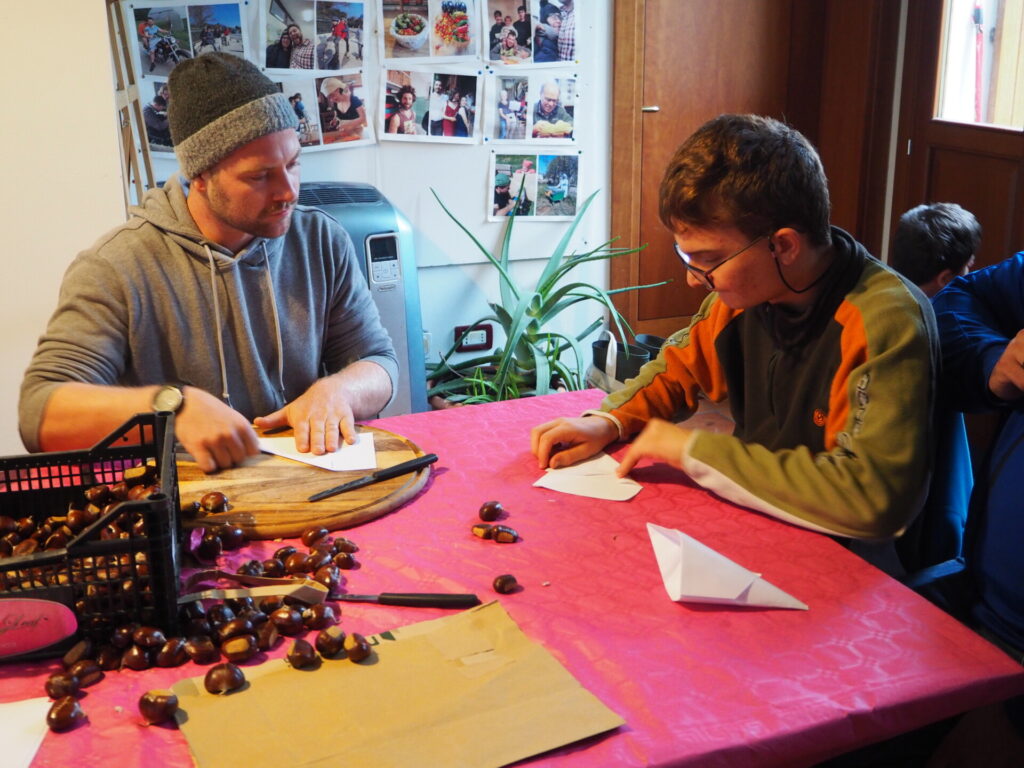




The foundation of the Inclutrain methods is empathetic perception. This involves putting oneself in the other person’s shoes, in the way they act. In doing so, one’s own will encounters the will of the other. This is easiest to achieve when carrying out an activity together and imitating the other person in the process. Any activity can be used for this: peeling potatoes, mopping the floor, weeding, writing a line, walking one behind the other … Imitating may feel a bit strange at first. It may also take a while to let go of one’s own perspective and fully engage with the other person – without judging their actions as good or bad. This is important, because empathetic perception only works when based on a positive attitude: ‘Interesting, that’s another way of doing it.’ Then one connects with a person and their way of acting, and can deepen this connection even further.
I remember my first attempts at empathetic perception very well. Together with Sonja, I was supposed to twist the leaves off the freshly harvested beetroots. I sat opposite her and began to carry out the task with concentration; my focus was on the beetroots lying in a box in front of me. My gaze was fixed on the box and hardly strayed from it. My hands worked nimbly. Then I remembered that the task was actually to imitate Sonja. So, with some reluctance, I shifted my focus away from the work and watched Sonja. It was challenging to work as she did and not follow my own impulse. She held the beetroots quite differently, using a different technique to remove the leaves. It felt strange to imitate her. The greatest challenge was to mimic the way she observed her surroundings. Her gaze kept wandering over the surrounding landscape and up into the sky, whilst her hands carried on working. I was reluctant to look up from my work and let my gaze drift off into the distance. But when I did, I saw what she saw. The cloud-covered sky, the surrounding woods and a few birds flying across the sky. I was struck by the sense of vastness that opened up within me. Above all, however, for the first time I felt as though I had put myself in Sonja’s shoes. In the vastness of my gaze, I was completely with her. I describe the experience with the words ‚expanding while dreaming’ – Sonja’s impulse to act.
I had assumed that imitation would be a simple task. Yet it turned out to be quite challenging. However, once you have taken the step towards empathetic perception, a new world opens up. It is a source of inspiration for designing person-centred collaboration with people who require support – a foundation for creating inclusive learning spaces.