


As described in the window above, the impulse to act can be represented not only with verbs, but also through drawings and paintings. This enables a non-verbal form of communication about the impulse to act.
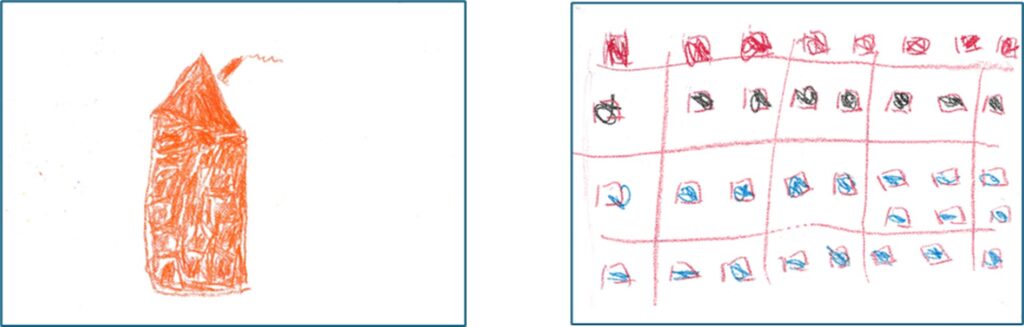
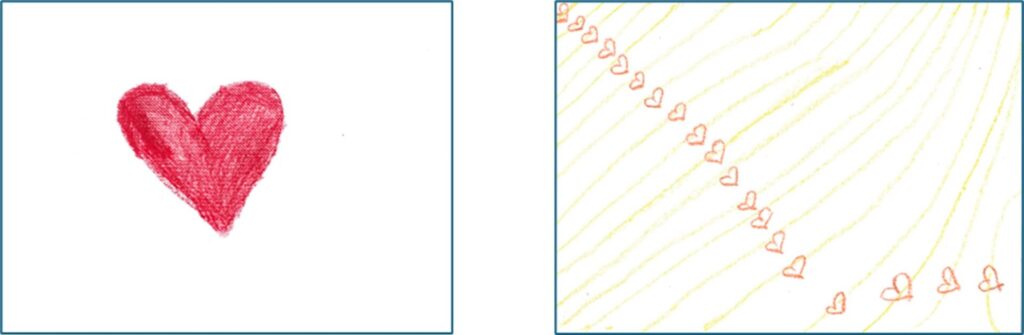
Drawings are individual representations that always contain the self of the artist. This becomes apparent when one compares a person’s drawings of their own impulse to act with those of someone else’s. Here are two examples:
Christoph on his own impulse to act Christoph on Nadja’s impulse to act
‘maintaining while selecting’: ‘aiming while organising’:
Julia on her own impulse to act Julia on Nadja’s impulse to act
‘feeling while delving’: ‚aiming while organising’:
One participant reflects: “During the art exercise, I noticed that one’s own impulse to act always finds its way into the drawings of others’ impulses. When I drew Erich’s impulse to act, I did it my own way: ‘affirming with purpose’. I first sketched the shapes and only coloured in the open spaces afterwards. Erich, on the other hand, first coloured the page and then drew the shapes within the coloured areas. His impulse to ‘refine whilst resting’ was evident in his drawing style and in the drawing itself.”
One can connect with a person’s impulse to act not only through drawing or painting, but also through music. You can read more about this in the article ‘Making music of the impulse to act’.