



Once you have discovered the impulse to act and connected with it, you can use it as a source of inspiration for your educational work. Embracing the impulse to act opens up new forms of guidance and collaboration.
‘Exaggerating while portraying’
I am a work support mentor at Urtica De Vijfsprong, a social farm in Vorden, in the Netherlands. Recently, I was walking across the farm grounds and came across a resident, Markus, who was stroking a cat: “Dear cat! Come here, dear cat. Yes, cat, come! You don’t need to be afraid. Come here. I’ll stay with you.” As I watched him, I immediately recognised his impulse to act as ‘exaggerating while portraying’. With him, you get the feeling that he isn’t just talking to the cat, but putting on a whole performance for an audience. At that moment, I, who was just passing by, was the audience. That’s how he always does it! He turns what he does into a performance and looks at the audience.
Many people find his behaviour irritating, which is why they react with rejection. However, this is how he always behaves. It is his individual impulse to act. Can I accept his way of acting instead of rejecting it?
Accepting and aligning to the impulse to act
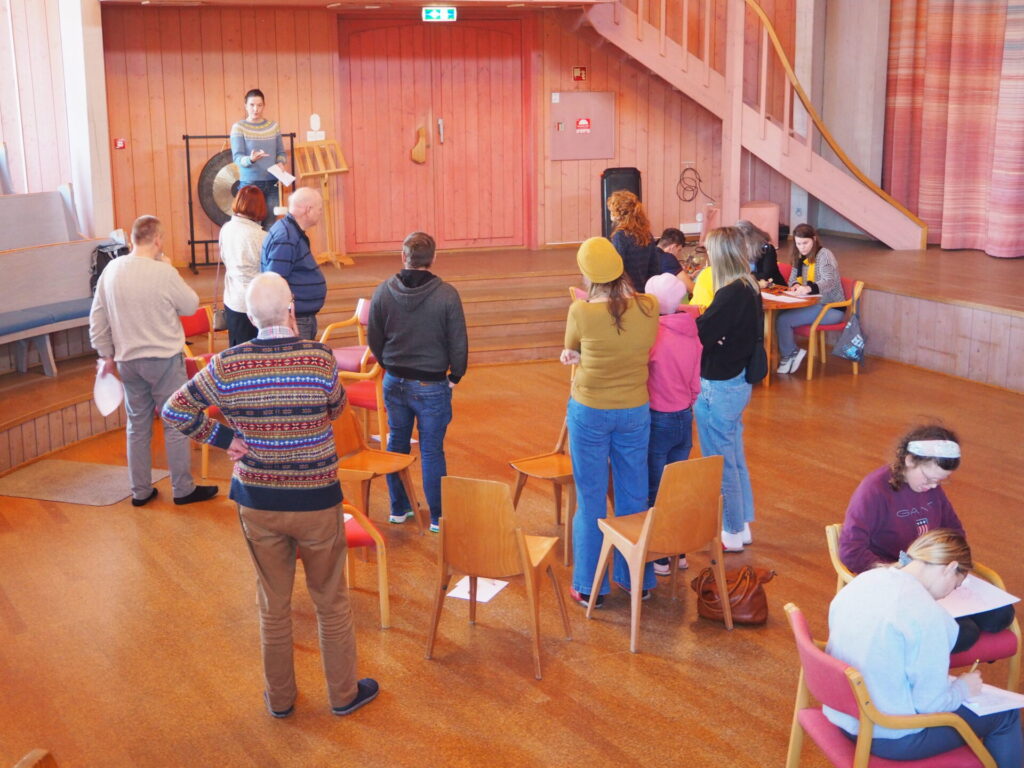
We start every day with a morning circle, attended by about 20–30 people. Markus often helps me hand out the sheet music for the songs we sing together. In this situation, I want to try to accept his impulse to ‘overact’.
I call out to him loudly and wave the sheets in the air: “Markus, hello, I need your help with the song sheets!” He comes dancing over straight away. I bow deeply to him: “Thank you very much!” He replies with an equally deep bow. I make a show of handing out the sheets. Markus joins in.
Learning spaces that inspire!
For me, there were four discoveries regarding the design of the learning space following the impulse to act:
- I practised ‘exaggerated acting’. That’s not at all easy for me.
- But I enjoyed it.
- Markus also enjoyed joining in with the acting.
- The people in the morning circle, who usually stand there half-asleep, chatting amongst themselves and not really looking at the sheet music, were all wide awake and fully engaged. They also enjoyed the performance.
Accepting another person’s initiative, while it may certainly be challenging, helps us try out new ways of guiding and involving others in the group who need support more effectively when we engage them in collaborative work. This makes our educational work more creative and better tailored to the individual needs of the people we support.