


Victoria’s qualities have emerged and are flourishing!
This article describes how Victoria’s vocational training at Loidholdhof was structured using the Inclutrain method.
Victoria introduces herself:
“My name is Victoria and I’m 28 years old. I’ve been working at Loidholdhof since November 2015. In the mornings I do the laundry and in the afternoons I help out in the stables. I grew up on a farm, so this sort of life is quite normal for me.
I enjoy writing and reading aloud. I also like looking after other people. For example, I help Antonia with the stairs or look after Silke. I’m also a representative for the farm, so I can help others there too.
I really don’t like it when people don’t stick to things or just change them and I no longer know what’s going on. I can get quite loud and emotional then!
When something makes me really happy, I go to my work support mentor, Erika, and give her a hug!
When something makes me really sad, I also go to Erika, give her a hug and hold on tight to her.”
Holding on tightly
Victoria’s impulse to act is ‘holding on while embracing’. For her, the two impulse to act verbs are very closely related. Her way of ‘holding on’ isn’t like holding a teacup by the handle, for example. It’s more like holding a mug of hot chocolate in your hands on a cold winter’s day: you almost want to wrap your whole body around the warm mug.
When thinking of a career for Victoria, ‘nurse’ or ‘lifeguard’ came to mind.
A talent for reading and reciting sayings
Victoria’s talent lies in reciting sayings or texts beautifully. When Victoria reads sayings or texts in front of other people, she is fully absorbed in the task and recites the content loudly and clearly. Even when many eyes are fixed on her, she remains focused and does not allow herself to be distracted.
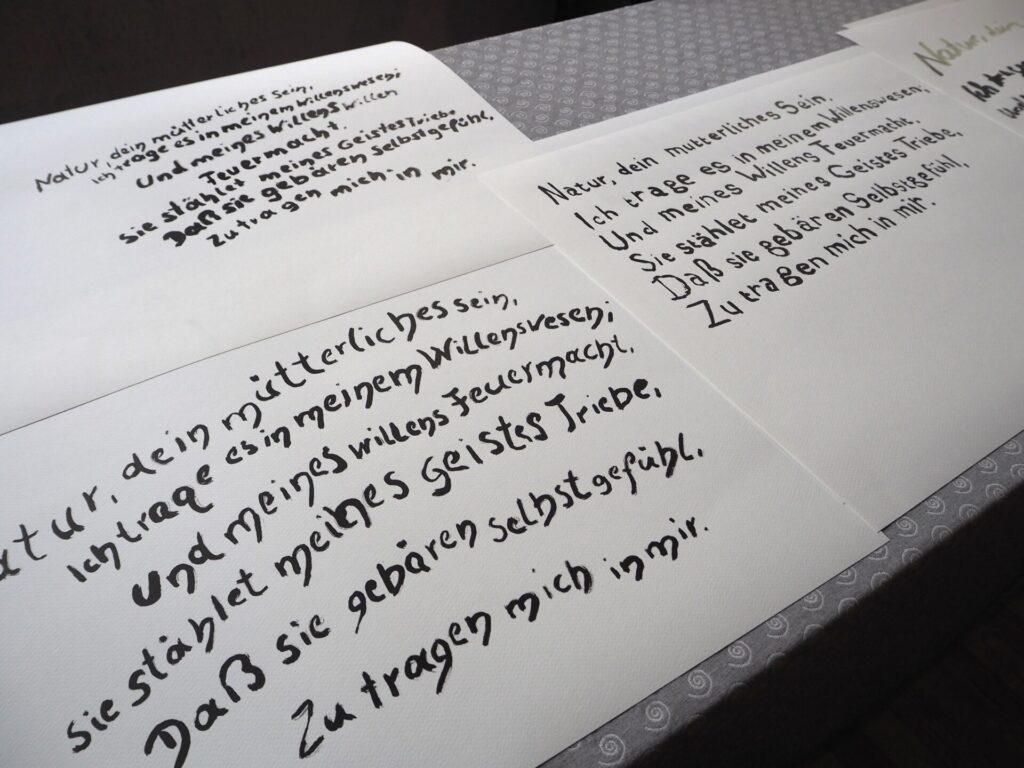
This was evident during our daily morning circle, where she would repeatedly pick up the little book of verses of her own accord and recite the weekly verse clearly and comprehensibly. Our painter at the farm also noticed her talent. So one day he asked her if she would like to come to the painting workshop once a week to write with brushes and paint.
“I read the verse during the morning circle. And the writing boards are there; not all of them, just the one with the verse I’m reading at the moment.
Since February 2021, we’ve been meeting every week in the painting workshop. I wrote the first sayings on paper, the rest on boards.
I remember it all started when I wrote “Ronia the Robber’s Daughter” on a piece of paper for my friend Roland – because he wanted me to write it down for him. He left the note by the coffee machine, and when the painter walked past and saw the note, and I was somewhere nearby, he asked, ‘Who wrote that so beautifully?’, I said: It was me! That’s how it started.
The painter helped me with the writing – or rather, the painting. He cut the brush short, and for every letter I had to dip the brush back into the paint. At first I wrote just one saying and then placed it on an easel during the morning circle. Then I wrote the next one. And then, after a year, we were finished. We then put on an exhibition of all 52 sayings in the courtyard.
We arranged the boards with the sayings in a circle. Katha then asked me to write the sayings for her practice in Dortmund. I thought about it for a bit and then said I’d accept the commission and would be happy to do it, so I wrote all 52 sayings again.
Deepening skills. Reflection by the work supervisor
Victoria’s impulse to act is ‘holding on while embracing. The saying is already printed; she is already fully present. When she redesigns this saying on a board, writing or painting it large and freely, the whole must be retained, yet it looks completely different. By writing the saying boards, she can gradually deepen her ability of ‘holding on while embracing’. At first, she simply writes the sayings, learning in the process how to handle the brush and paint. Through working on the sayings every week, over several months, she increasingly discovers their content and connec-tions. Her ability to focus on a task and immerse herself in it takes on meaning and enhances this ability. Over time, she begins to reflect on the sayings and develop her own thoughts about them:
Dialogue on the Sayings and the Life of the Self
Hannes: For some time now, you haven’t just been copying out the sayings, but we’ve been sitting down together afterwards every time …
Victoria: … and then I write down my thoughts.
Hannes: Is that difficult?
Victoria: Sometimes it is. The quote can be a bit of a puzzle now and then.
Hannes: Do you want to say anything else about the sayings? What are they about?
Victoria: About the ‘I’ life… on the one hand, the sayings have to do with me; on the other hand, they have a lot to do with the outside world. With how plants sprout, mature, bear fruit… with nature… how it changes from spring to winter, you could say.
Hannes: And in winter?
Victoria: And in winter everything’s bare outside… but inside, everything blossoms. (Laughs) I’m not quite sure how else to describe it. I feel like you never really finish with the sayings; you’re always discovering new things. And that it’s got to do with how you feel, too.
Hannes: With feelings?
Victoria: I think you learn to really feel yourself by feeling what you’ve written down. Learning to feel. Experiencing it for yourself, exactly.
Hannes: Yesterday you wrote: Do I have to feel the insight?
Victoria: I think it works, somehow. When you get to know the sayings in a way, you learn to feel them. I’m telling you honestly, it works.
Hannes: Was it a process of personal development?
Victoria: Yes, it was. I’ve developed more and more over the years. My handwriting has improved…
Hannes: What would you like to do in the future?
Victoria: I think it’s important that people learn to write properly, that they learn to form the letters. I don’t know if everyone can do that. I think for some people it’s an art form.
The change in collaboration. Reflections of a work mentor
Our Inclutrain training has completely transformed my professional work with Victoria. We are now aligned in a different way and my perspective on her has shifted. I no longer focus on what she cannot do or what bothers me about her. No, her impulse to act is now so present to me that it is exciting every time to see how I can build on it within a specific work, social or learning context. I experience this as a highly creative process, where I, as a work support mentor, am challenged as a whole person. Our relationship has changed. It has only really become a genuine partnership now. Since we’ve been trying this approach, Victoria and many of her colleagues have made amazing strides in their development. Things that were previously unthinkable are now becoming possible because we have a path we can follow that inspires us. It’s fun working with Victoria. I now feel like both a teacher and a learner at the same time!”
Another task Victoria enjoys is helping her colleagues with their diary writing. People dictate a text to her and then copy what Victoria has written.
And what professions has Victoria trained in?
Public speaker
Teacher: who gives writing and reading lessons to her colleagues.
Calligrapher: of poems and sayings.
Reader.
Philosopher.
More on this in the article ‘In Painting. On the Soul Calendar Panels’, in: ‘Das Goetheanum’ (2024-07): https://dasgoetheanum.com/in-der-malerei/