



The impulse to act can be expressed not only in words, but also through drawing or music. This opens up a new, non-verbal way of communicating with one another about the impulse to act.
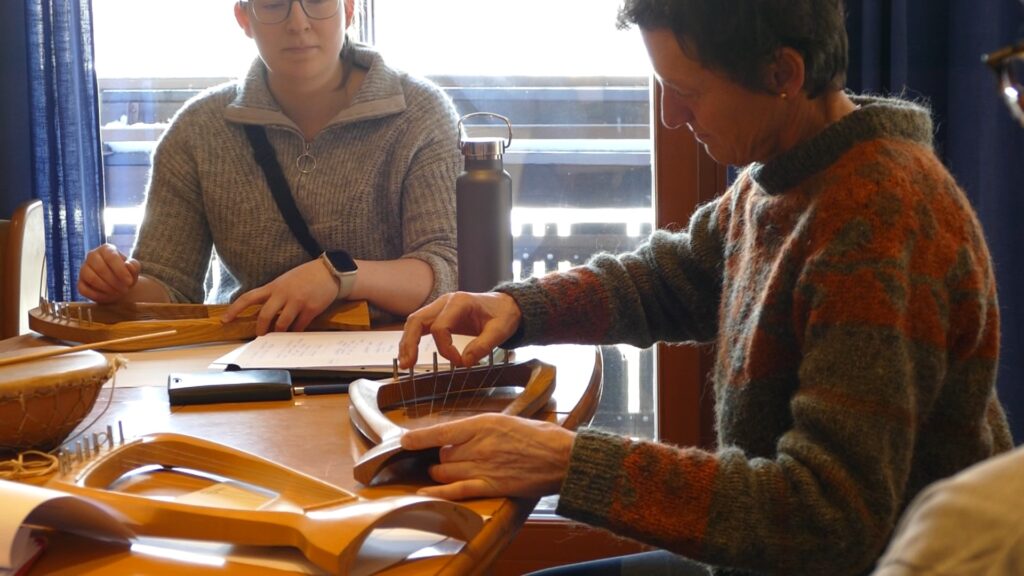
To represent the impulse to act musically, you naturally need musical instruments. The most suitable instruments are those that are easy to play without requiring years of practice – for example, a lyre or percussion instruments such as the xylophone, drum and tambourine. Now one person can begin to play and another person joins in. A space for free improvisation emerges, into which other participants can join. What is important here is perceiving and empathising with the music. Only in this way can one detect the impulse to act in the other people and connect with it. Below is an example of how the music exercise might unfold.
The music exercise
We are sitting in a group of nine people at a table on which various musical instruments are placed. In turn, everyone chooses an instrument and plays it. So I, too, take an instrument and demonstrate what can be done with it. The others observe how I play and then try to describe my impulse to act using two verbs. Then I play again and another participant tries to join in and play my way, that is, to reinforce my impulse to act.
We repeat the exercise with all the participants. The way participants respond to each other’s impulses takes on very individual forms. Vivian chooses a drum to play. He begins by striking the drum in a very regular rhythm. One beat follows another, and at the end he delivers a loud final beat. We describe his impulse as ‘rhythmising while beating’, linking it to the profession of a musician or conductor.
In the next step, Franziska also picks up an instrument and joins in with Vivian’s impulse by participating in the ‘rhythmising while beating’. After that, Miriam speaks up, responding to Vivian’s ‘rhythmising while beating’ in a different way. She plays a gentle melody to the given rhythm.
Vivian sticks to his style of ‘rhythmising while beating’ right to the end and finishes with a loud final beat.
I then reflect: “It was fascinating to see how the impulse to act becomes visible in the way we make music – just as it manifests itself in other actions. It is helpful to demonstrate how to play the instruments. This helps overcome any shyness about making music freely.”
New forms of expression and communication
In making music, a different form of expression and communication becomes possible. When joining in, the music meets the music. For example, a particular rhythm encounters a particular melody – without any prior agreement being necessary. Verbal communication becomes obsolete in these moments. Speech does not stand in the way of those communicating. Instead, the person joining in tunes in and asks themself: “What does the given situation require? How can I contribute something? How can I join in? What is special about what the player is offering?
When the responder utilises this perceptive ability and adds their own contribution, two impulses to act touch and connect.
When several people with this capacity for empathy make music together, an orchestra emerges, a symphony of individualities linking together. When a different individuality is the starting point of the music, a different symphony resounds.