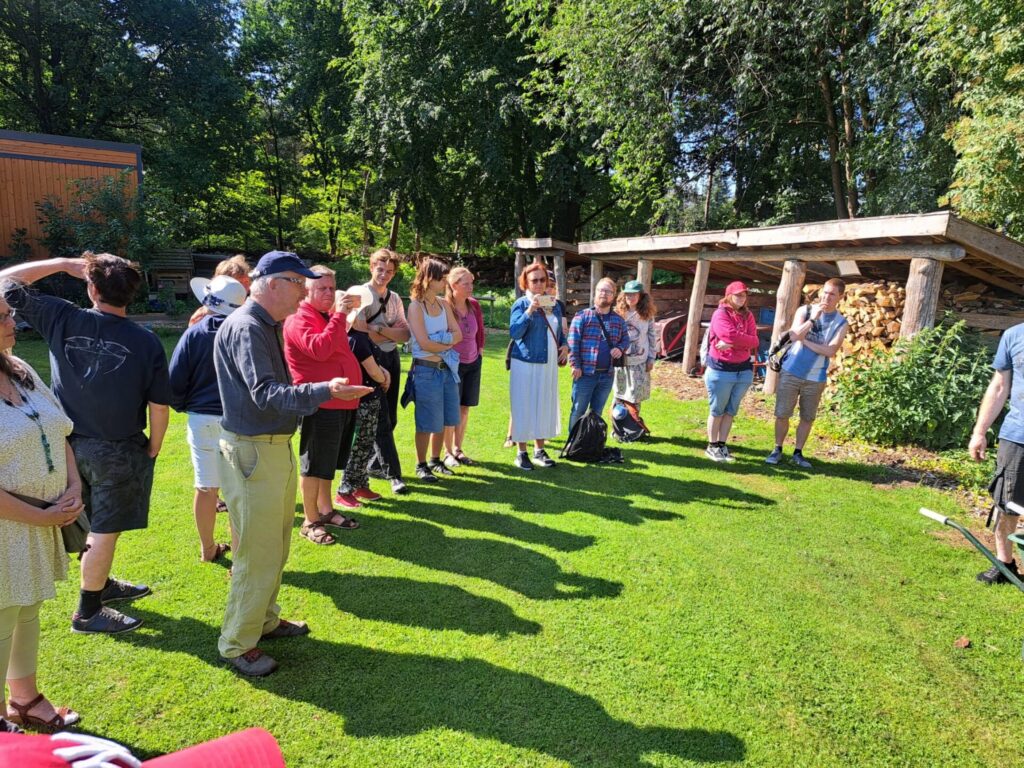




As an Inclutrain trainer, I gave the work support mentor Rainer the following tip on how to connect with Max’s impulse to act – ‘securing while observing’ – whilst they were stacking wood together: “When you’re stacking logs, say out loud what you’re thinking as you do it. Speak freely into the room, not to Max!” Rainer took my suggestion on board, even though it clearly felt unfamiliar to him: “Not to speak to Max, but just to talk out loud to myself like that?” (More on this in the previous window.)
From the outside, my intervention looked as though I already knew everything, as if it had been perfectly clear to me from the start how I could support Rainer in aligning with Max. But it was also a surprising experience for me. I hadn’t known beforehand that I would guide Rainer in this way. For me, it was a successful unexpected action. An action in which I intuitively accepted the other person’s impulse to act – in this case, Rainer’s.
A few weeks later, I was in an peer group. There, we discussed how I had aligned with Rainer. First, my colleagues characterised my actions and then Rainer’s:
Characterisation of my actions by the peer group | Characterisation of Rainer’s actions by the peer group |
You told Rainer what was going through your mind when you were stacking wood yourself the other day. | Your assessment of Rainer’s impulse to act is: “Rainer gives the instruction and continues to watch.” |
Verbs: ‘thinking while narrating’ | Verbs: ‘watching while withdrawing’. |
Occupation: Druid or priest | Occupation: King or warlord |
Through my action of ‘thinking while narrating’, I participated in Rainer’s ‘watching while withdrawing’ and reinforced it. In doing so, I aligned myself with Rainer. Rainer’s ‘instructive stepping back’ was thus able to manifest itself quite differently: he says what he thinks, but does not speak directly to Max. Rainer, as it were, gives the instruction aloud as to how the wood should be stacked and demonstrates ‘securing while observing’ to Max without engaging him directly in conversation.
This is a description of what I did intuitively. When I describe it as a method of experiential learning, I realise that I did the following:
I looked for my own experience of ‘securing while observing’ whilst stacking wood. When I stack logs, I look at the logs and consider how I can stack them safely – without, of course, verbalising this process. I realised that when stacking wood, I proceed by ‘securing while observing’, just as Max generally does. Building on these observations, I suggested to Rainer that he voice his ‘stacking thoughts’ aloud so that Max could share in them. Based on my own experience, I suggested that he think aloud without engaging directly in conversation with Max.
What comes to mind from one’s own experience is an intuitive process. It is something that responds from within to the external situation, or rather, to a necessity. It enables us to shape new forms of the learning space.