


We have already seen in the window ‘The Self and the Other’ that the self is always expressed in the impulse to act drawings. This can appear even more specifically as per the following example
The exercise
To identify the impulse to act, we imitated a person’s movements by walking behind them. The task was then to express our own experiences regarding the perceived impulse to act in a drawing. After drawing for about 5–10 minutes, we looked at the drawings together with the person we had imitated.
One motif, two impulses to act
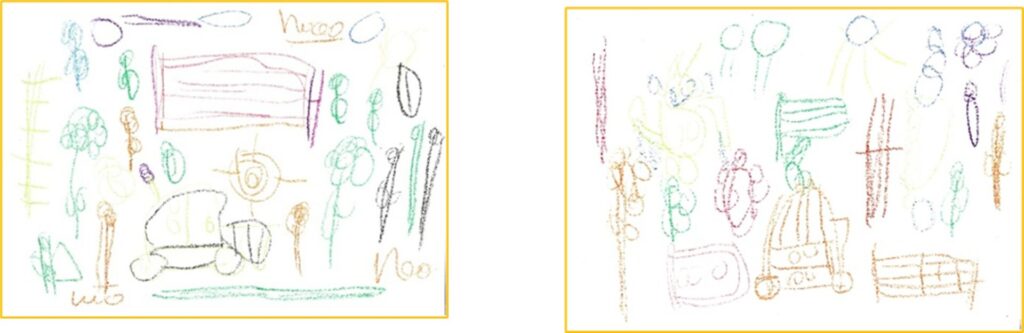
First, we drew Jan Hendrik’s impulse to act: ‘immersing while exploring’. Mario drew all sorts of elements of a farm: a tractor, a cow and so on. I didn’t really know what to make of it. It seemed as though he had simply drawn what he liked or what he always draws. Then we put ourselves in the shoes of a second person, Herbert, for whom we identified the impulse to act as ‘measuring while observing’. We began drawing again. And Mario drew his farm again.
As I looked at Mario’s drawing, I suddenly had the idea of placing the two drawings side by side. And although both depicted a farm, the differences revealed what I and the other participants had said about the differences in our own drawings. For Jan Hendrik, we had identified the role of a bomb disposal expert, whilst Herbert’s impulse to ‘measure while observing’ manifested itself quite differently.
Jan Hendrik had drawn a landscape on both occasions. The difference between his landscape drawings was along the same lines as Mario’s farm drawings.
Mario’s farm drawings
Jan Hendrik: ‘immersing while exploring’ Herbert: ‘measuring while observing’
Insights
- Assume that the other person is doing his or her best to complete a task. They cannot do it any other way than in their own way.
- Focus on the individual person expressing his or her experience. Do not generalise too quickly.