



The step of accepting and aligning to an impulse to act is often perceived as difficult. It requires a certain amount of creativity to think outside the usual framework.
Many of the impulses to act seem to point to a relationship between people, which is why acceptance is sought within the same sphere. If, for example, the impulse to act is described as ‘connecting while loving’, it is assumed that the person must find new friends in order to feel at ease. Or an impulse to act such as ‘excluding while appropriating’ is used to explain why the person occasionally comes across as distant and unfriendly. Such considerations at the relationship level are, however, not productive.
It helps to adopt new perspectives by seeking out the impulse to act in one’s own experience with things i.e. when the impulse to act relates to the material world and is recognised in one’s own activities, for example:
‘Connecting while loving’
I recognise this from my experience of preparing a béchamel sauce. If I add water or milk too quickly to the flour heated in butter, lumps form. If I add the liquid slowly, drop by drop, stir, and allow time in between for the whole mixture to warm up and combine, it becomes a smooth sauce. The process of becoming a sauce is ‘loving connection’. It only becomes a lovely sauce when the flour, milk and butter are ‘connecting while loving’ one another. As a cook, I must also accept the sauce’s impulse of ‘connecting while loving’.
For a person with the impulse of ‘connecting while loving’, this might then mean: getting to know a new task, job or workplace step by step, and not too quickly at the start.
‘Excluding while appropriating’
In interpersonal relationships, one doesn’t want to exclude anyone at all. At least not when working on something as part of an inclusive approach. But when I make an appointment and look at my calendar, I can see in a flash which days I’m unavailable and which days are left. Most of the time, I only communicate the latter – that is, when I’m free. When I verbalise the whole process, I’m ‘excluding while appropriating. So there are situations in everyday life where ‘excluding while appropriating’ serves an important function.
It appears here as a perfectly normal approach, which I can communicate to others much more often. Because then the others can follow my process and get on board. The others are then involved in the process of ruling out options.
These activities therefore provide an impulse to act. From personal experience, one knows how to accept this.
The Crawling Caterpillar
With Nadine, I arrived at the impulse to act as ‘leading while pulling’ and, as a profession, tour guide.
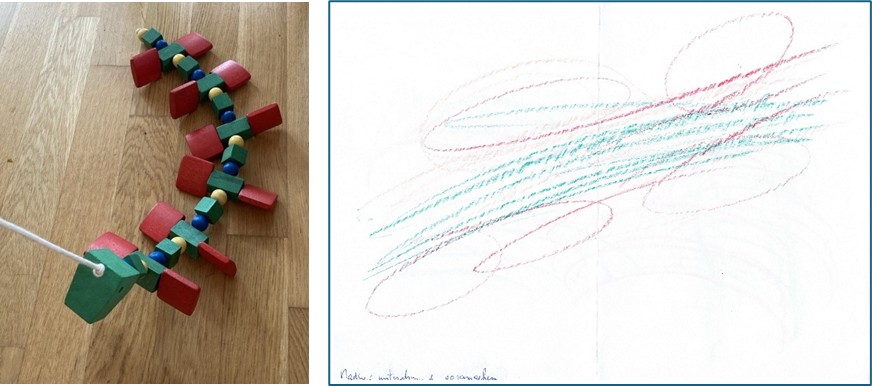
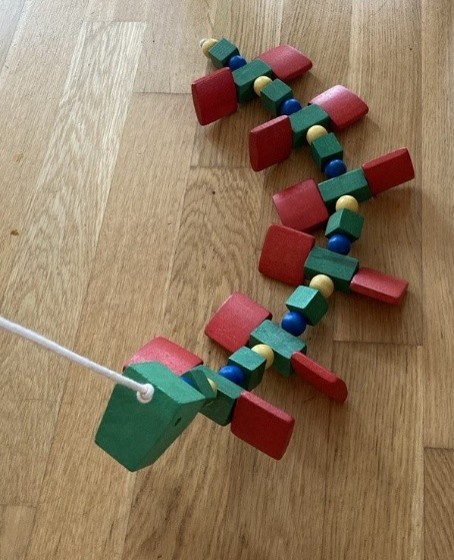
Two days later, I saw a pull-along caterpillar toy in a shop. I noticed, how the toy caterpillar’s head leads the way and all its legs turn at the same time. However, when I lead the caterpillar along pulling it behind me, it flies off course if I walk too fast. For me, this caterpillar was a material expression of ‘moving forward while pulling’. This realisation helped me to accept Nadine’s impulse to act.
I was even surprised when, a week later, I looked at the rough sketch I’d done as an intermediate step – before I’d identified her impulse to act, and before I’d discovered the toy caterpillar. In the sketch, the caterpillar, with its twirling legs, is already ‘suggested’.