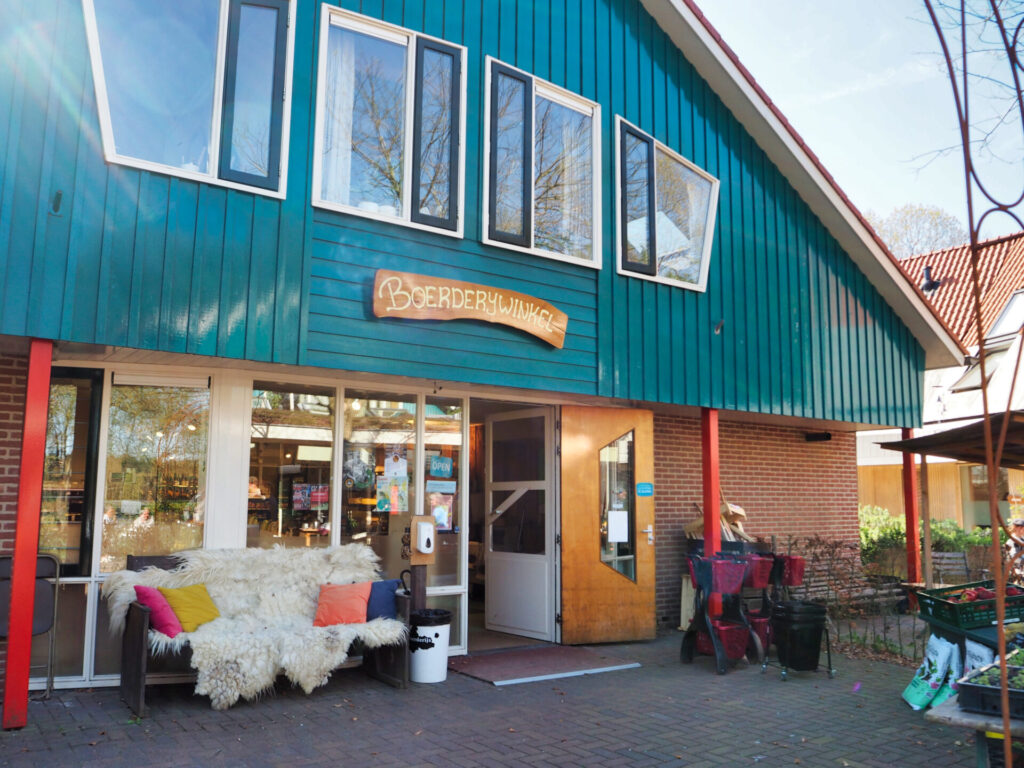




Urtica de Vijfsprong is a therapeutic residential and working community for people requiring support, located in Vorden, the Netherlands. The residents are people with intellectual or mental disabilities who receive support through living and working on the farm.
At the heart of the community is the 70-hectare biodynamic farm. There are around 70 dairy cows and young stock. The milk is processed directly on the farm. There is also a market garden, a woodland and an on-site organic shop, where farm-produced goods such as vegetables, cheese and meat, as well as purchased products, are sold. The housekeeping department, including the kitchen, is also a work area. The organisation offers various options for living and working, such as the Hofhuis, an old farmhouse where nine people live with individual support.
Inclutrain at Urtica de Vijfsprong
Urtica is a long-standing Inclutrain project partner. The organisation has played a leading role in the project since the Inclutrain project was launched in 2017. Staff and clients are directly involved in developing the project content as well as in delivering methodology training.
Activities 2023–2026
As part of the Inclutrain extends project (2023–2026), representatives from Urtica de Vijfsprong took part in six training activities in Austria, Germany, Norway, Italy and the Netherlands. A total of 20 people from the organisation attended training activities on one or more occasions. These included both people with and without support needs.
Furthermore, staff members from the organisation were involved in six process group meetings. Two staff members completed the trainer training. They took part in the monthly trainer meetings as well as in digital staff exchange meetings.
At the end of the project, Marianne and Helga – the two project leads at Urtica – look back and evaluate: How have the methods taken root? And how, as a result, have collaboration and organisational structures changed?
Portfolios
The Inclutrain portfolio, which illustrates a person’s qualities using concrete examples, forms part of the overall documentation system at Urtica and is thus structurally embedded within the organisation. Inclutrain portfolios exist for all clients and for some staff members. The portfolios are used as inspiration to develop approaches for successful collaboration (even in difficult situations). The portfolios are regularly consulted, revised and further developed. In future, work objectives are to be formulated on the basis of the impulse to act.
Client participation
Marianne describes how she actively involved the clients in shaping the training activities. Through the implementation of these methods, clients have taken on an active role within the organisation. They are not merely recipients of support, but become active participants who help shape their own learning processes. This boosts clients’ self-confidence and fosters their independence, leading to greater inclusion. This represents a significant paradigm shift.
Personal development of staff
Staff members who work with the Inclutrain methods are now increasingly able to view behaviour that is generally considered disruptive from a positive perspective. The method helps staff members to recognise positive qualities even in pedagogically challenging situations and to implement interventions based on these.
“I’ve noticed that I’ve grown personally through the method. I realised this, for example, when I was running a training session with a group from Norway. One client didn’t want to take part. Her work support mentors workers apologised to me several times for her behaviour. But I turned her negative judgement into a positive response. I asked her: In what situation is it good and important to say ‘no’? We had an interesting conversation about it and reflected on saying ‘no’ and its importance based on our own experiences. It was a very stimulating conversation, and finally I said to the work support mentors: ‘See, saying no is a quality. You can learn that from Mary.’ I was then pleased because I had managed not to dwell on the negative judgement, but to recognise the quality.”
The method helps participants step back from a negative perspective and find new approaches to collaboration. Staff members who have taken part in training activities on several occasions describe how they have noticed personal development through their intensive engagement with the methods.
Sharing the method within the organisation
Staff members who have completed the trainer training offer open training sessions for colleagues. During these sessions, for example, they work on portfolios using practical tasks. Furthermore, staff members experienced in Inclutrain incorporate their methodological knowledge into staff meetings when a situation is described as challenging or overwhelming.
“There are clients who are very difficult to work with – for example, they don’t want to get up in the morning or quickly become aggressive and irritable. Colleagues often come to me and ask how I manage to motivate these people to do something. I use these opportunities to talk about the impulse to act and to introduce the Inclutrain methods. I believe this helps my colleagues to remain capable of taking action even when they consider a situation to be hopeless.”
Being seen and recognised as valuable
A client from Urtica reports: “At first, I didn’t want to take part. I didn’t want to hear yet another diagnosis. But then I plucked up the courage to give it a go. We were cutting tomatoes and Marianne and Charlotte were mimicking me. They identified my impulse to act and a suitable image of a profession. And it was lovely. It was lovely because they recognised something genuinely positive in me. Not always these clinical pictures and diagnoses – but simply the way I do things and that it’s good the way I do them.”
The evaluation shows that clients feel seen and valued when the Inclutrain methods are applied in the working relationship. The focus is not on shortcomings, mistakes and diagnoses, but on strengths and abilities. This empowers people and motivates them to take new steps in their learning and development.
Challenges in implementing the methods
It is evident that we have not succeeded in arousing the interest of all staff members in the Inclutrain methods. In the residential sector, introducing the methods has proved more difficult than in the workplace. This is hindering the organisation-wide implementation of the method.
As the method is very practice-oriented, the organisation’s internal Inclutrain trainers often find it difficult to explain the methods verbally to people with a critical or dismissive attitude and to involve them in the project. Discussions about the method have proved to be ineffective. The starting point for experiential learning is to act, which cannot take place when you are discussing. It would, however, be more effective to motivate colleagues to try out the methods for themselves – to invite them, so to speak, to take part in an experiment in which the (research) questions can be explored. It is only through personal experience that the method comes to life and becomes tangible.
Conclusion
The introduction of the Inclutrain methods at the Urtica de Vijfsprong facility has had a positive impact on collaboration. In particular, the development of portfolios and the active participation of clients in implementing the methods are promising steps towards a more inclusive and appreciative way of working. However, the full integration of the method remains a challenge.