



Klaus has a wait-and-see attitude. He prefers to sit on a chair and watch. It is difficult to get Klaus moving and motivate him to work. When Klaus is working, he often looks at his watch to see if it is time for a coffee or lunch break yet. As soon as the break bell rings, Klaus stops working and leaves everything as it is. For example, if the bell rings whilst he is unloading cutlery from the dishwasher, he stops working immediately and simply leaves the last few spoons in the dishwasher – even if there are only two left. When the bell rings, he rushes straight to the coffee. He wants to be the first at the coffee to sit in his usual spot.
I want to encourage Klaus to finish the task, but he always says: “No, it’s coffee time.” How do I get him on board? How can I organise the learning space so that it motivates him to get to work?
A successful, unexpected move
In the Inclutrain group, we’re thinking about a profession where Klaus’s behaviour would be a strength. A lock keeper or car park attendant springs to mind. They wait to see if a ship or car is coming and then open or close the lock or gate. They observe and calculate when the lock needs to be opened or closed. We come up with new verbs for Klaus: ‘calculating while observing’.
That reminds me of an example of a successful unexpected interaction. It was a situation where I intuitively aligned with Klaus. Whilst baking biscuits the other day, I asked him to keep an eye on the time so that the biscuits wouldn’t burn. It worked very well. He really enjoyed keeping track of the time.
Creating a learning space
I explain that I felt as though he was shirking work.
To which Albert replies: “That’s not important here. From the outside, it might look as though ‘calculating while observing’ isn’t work. But the real question is how to find your way to work via this route. That’s what aligning is all about. If you simply say there’s still enough time, Klaus has to believe you that there’s time to spare. But his impulse to act is ‘calculating while observing’. And that’s where he wants to improve. So you could do some smaller exercises where he can become more proficient in his impulse to act. So far, he’s specialised in keeping an eye on when the break is. The point is that he can apply this skill to other tasks as well. To do this, you can look at the process from the other direction, that is, from the result. You complete the work on time because you’ve calculated it correctly. Then you don’t have to carry on working during the break. You could say: ‘Look how quickly you need to do the work so that you can finish the tasks before the break.’ You could also do an experiment with him by doing the work very slowly once and then very quickly. So at different speeds. Then you can look back together and compare the differences. Klaus has this calculation built into his impulse to act, yet at the same time he is not yet able to use it positively. You can support him in this by accepting his impulse to act and moving together with him.”
Through the conversation, it became clear to me that every person wants to make their abilities available to society. Observing and calculating is mental work, not physical. Therefore, it is not immediately visible.
Flowing with the impulse to act
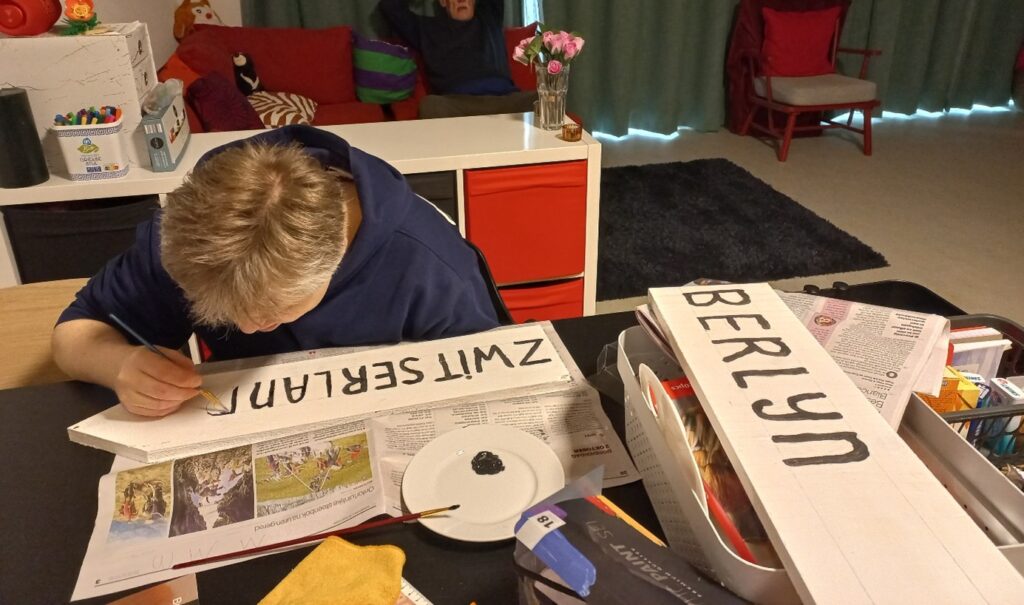
Some time ago, we wrote the names of various towns on wooden boards. They were signposts, so to speak. This was a gift for a colleague who was retiring. I drew the outlines of the letters and Klaus filled them in with paint. Klaus was completely absorbed in the work. He worked with great concentration and precision. He clearly took great pleasure in designing the boards. And then, when it was time for a coffee break, Klaus said: “First I’d like to finish writing this place name and then go for a coffee break.” I was very surprised by what he said. I’ve known him for 18 years and he’d never said anything like that before.
Albert (trainer): When you draw the outlines of the letters, the shape is already there, waiting, and he fills it in. So you drew along with him and, in doing so, accepted and aligned Klaus’s impulse to act. You thereby created an environment that invites him to participate in his own way. When you accept the impulse to act, the person can learn something from it. It’s easier to learn when you see something demonstrated. You’re then engaged and free at the same time.