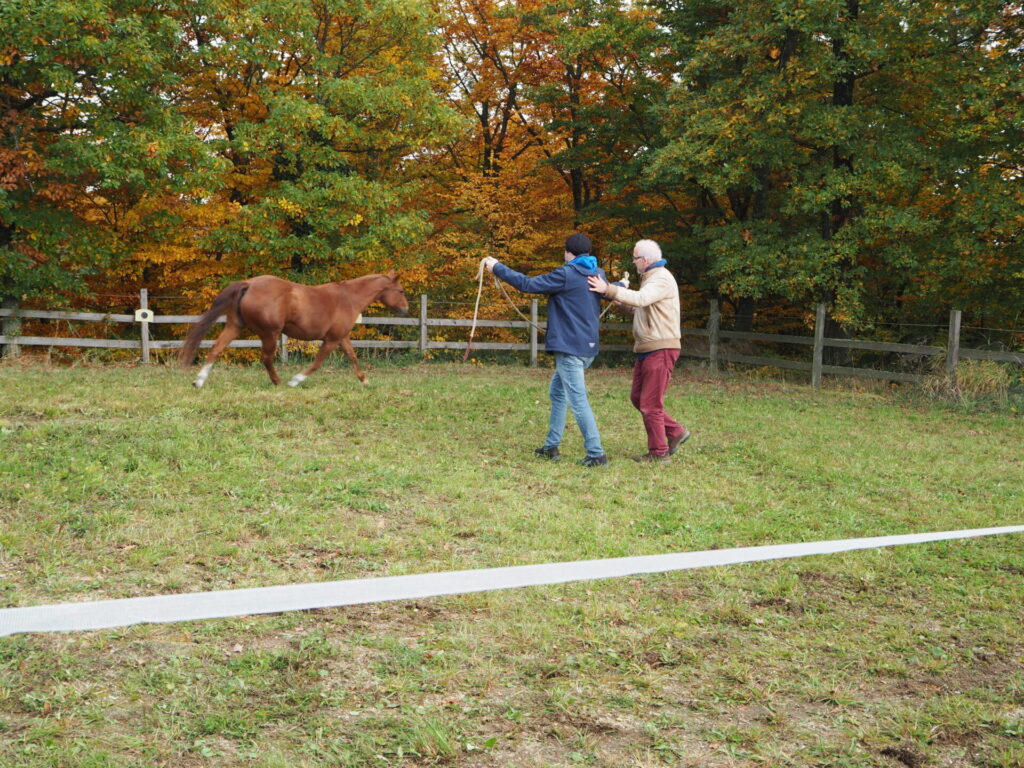




Three types of leading can be distinguished:
- Leading while guiding,
- People-centred leading,
- Vision-led leading.
Each type of leading has its own qualities. All three can be used in a fruitful interplay with one another.
An exercise:
In the following exercise, you can experience the three types of leading. The participants form two groups and line up one behind the other. The person at the back places their hands on the shoulders of the person in front and guides them through the surroundings. First, the person leading from behind focuses for a few minutes solely on their own hands, then for a few minutes on the person being led, and finally on something far away. The person at the front allows themselves to be led with their eyes open. There should be no talking during this time.
Afterwards, the experiences with the different styles of leading are discussed. Then the participants swap roles.
- Reflection from a participant after being guided: “When I was being guided, I felt like a robot. I couldn’t really tell much difference between the first two types of guidance. However, when I was guided by the vision, things suddenly moved much faster.”
- Reflection from the participant who led: “I also found that leading from the vision led to an acceleration. When I led in a controlling manner, it felt very narrow-minded, as I was only concentrating on my hands and the steering. Person-centred guidance was much freer because I focused entirely on the person in front of me. However, it also seemed a bit pointless to me, as there was no goal, no direction. Guiding from the vision, on the other hand, was purposeful. The pace quickened. I felt the need to walk alongside the other person rather than behind them. I wanted, so to speak, to move towards the goal together.”
The three types of leading in everyday working life
When we’re working in the stable, it makes a difference whether I dictate every single move – that is, whether I say, ‘You do this… you do that…’ (directive leading) – or whether I ask, ‘What would you like to do today?’ (person-centred leading).
The first form (directive leading) leaves little room for personal initiative. The person giving instructions specifies step–by–step what needs to be done. And the person being instructed either follows the steps or doesn’t. Once a task is completed, the next one follows, and so on.
The situation is different with person-centred guidance. This often leads to perplexed expressions when the other person doesn’t know what to make of the completely open-ended nature of the question. People start thinking about what they actually want. What is needed or what necessary tasks need to be done are completely overlooked in the process. A certain aimlessness becomes apparent in purely person-centred guidance. In contrast, leading from a vision is about creating a picture of the end result that everyone can be satisfied with. For example: The cows are hungry now. They were fed hay before the tea break. When you create such a picture, people are invited to participate in the task in their own way – that is, using their own initiative and their own qualities.”
Another example: When it’s time to prepare dinner, I usually have to ask the residents directly to help out. I might say,: “Could you please set the table?” or “Please put the kettle on.” The residents usually do this, but it’s a bit of a hassle to ask each one individually. Recently, I tried something new and said: “How can we make sure we can eat together at 7.30 pm?” Everyone felt addressed and shared the responsibility for ensuring we could eat together on time. Everyone pitched in and helped.
Creating a shared vision?
One might now ask whether leading from a vision also enables the creation of a shared vision? Can we empower those in our care to help shape the vision? And thereby strengthen their ability to recognise what needs to be done and what is required?
It is beneficial to foster a sense of (shared) responsibility and independence among those in care. However, the question “What’s on the agenda today?” can also be unsettling. It can be perceived as a leading question or an exam situation if those in care assume that the work support mentor expects a very specific answer – which is often the case.
When leading from a vision, it is important to have a vision of one’s own; otherwise, one cannot lead, but only follow. One must share one’s vision with the group. For in doing so, one opens doors for others to contribute. However, one should not fall into the trap of believing that everyone (must) have exactly the same picture in mind. Working together on the vision means that everyone has their own personal picture whilst also being inspired by the visions of those around them. This means, for example, that one person has the vision of eating at 7.30 pm, whilst another envisions sitting together. One is satisfied with one thing, the other with another. These visions do not exclude one another, but rather stimulate one another.