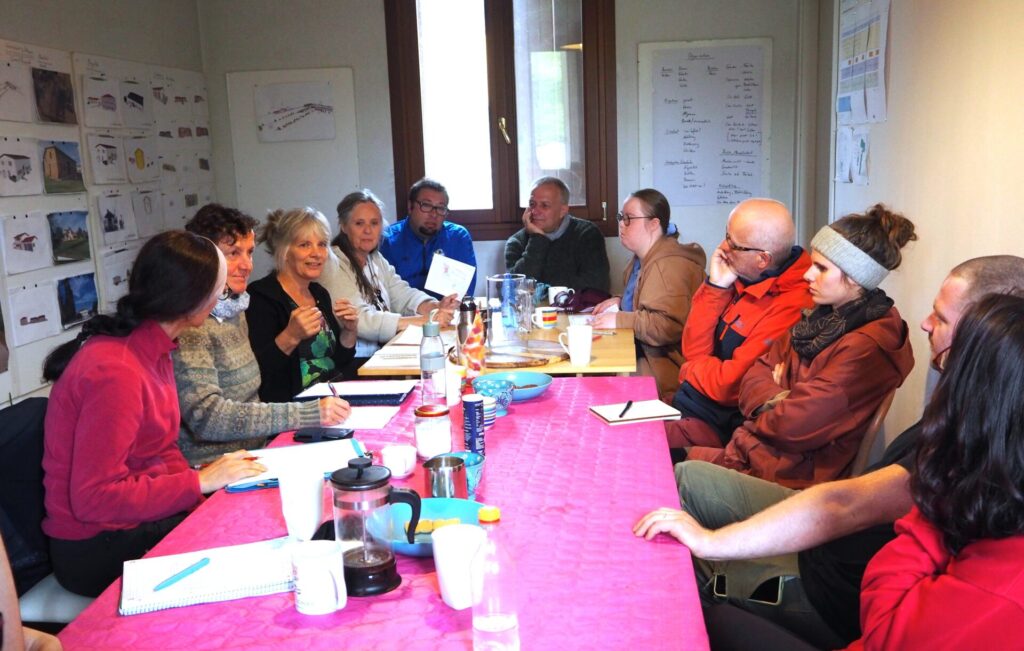




An example of how misunderstood or disruptive behaviour by a person requiring support is discussed in a team meeting:
Exploratory team meeting: Exploring what is not understood
Peter: I want to talk about Karl. Last week there was a hopeless situation. This really needs to change
Team leader: Yes, I read it in your report. Karl had one of his moods again. You put up a brave fight.
Peter: Well, it was a horrible experience for me. Fortunately, help arrived quickly, but I felt powerless. It’s like he’s doing it on purpose. He ignores me. And the constant running away. Because of his autism, he knows exactly when it’s time for dinner, and yet he runs away. I don’t know if he’s in the right place here anymore. Shouldn’t he go to a closed ward? Shouldn’t we call in an expert?
Team leader: Before we take any rigorous steps, perhaps we can first try to develop a better understanding of Karl’s actions. Who has experienced a successful unexpected action with Karl?
Jochem: Me! I found Karl on the edge of the institute grounds. He looks out over the polders. I was happy to have found him. It was then my job to get Karl to come with me to the house. Karl can completely ignore me or others in such a situation. I also had more to do. The search for Karl had already taken a lot of time. Normally I shout: „Hey Karl, come!“ But this time I stood next to Karl. I also looked out over the polders. Then I intuitively said what I saw: „It seems like the mills are turning slower than yesterday.“ Without further delay we went home together.
Team leader: We have already described Karl’s impulse to act as ‘concentrating while formulating’. This has something to do with wanting to stand still, wanting to come to the essence and then wanting to express this essence. In dealing with Karl, we can examine whether this formulating, this expressing aligns with Karl. Who has a situation where he was stuck and where we can try to imagine the development of the situation by aligning with Karl’s impulse to act?
Anja: I see something right away. Karl often comes to the house of our group. He looks around a lot. The people who live there find this threatening. I tend to send Karl away. Now I see that I can help him by formulating what he sees and what we do. Even if I sit across from Karl, in my mind I can stand next to him and formulate what I see.
Team leader: Okay, fine! I suggest that we try to imagine another situation exactly like this at the next meeting. Let’s especially record the successful actions in the daily reports so that we inspire each other.
All too often, a meeting like this turns out quite differently:
Traditional team meeting: The problem is tackled
Peter: I want to talk about Karl. Last week there was a hopeless situation. This really needs to change.
Team leader: Yes, I read it in your report. Karl had one of his moods again. You put up a brave fight.
Peter: Well, it was a horrible experience. Fortunately, help arrived quickly, but I felt powerless. It’s like he’s doing it on purpose. He ignores me. And the constant running away. Because of his autism, he knows exactly when it’s time for dinner and yet he runs away. I don’t know if he’s in the right place here anymore. Shouldn’t he go to a locked ward? Shouldn’t we call in an expert?
Team leader: Yes, if this goes on, Karl will have to be transferred. We can’t keep him here like this. But the closed ward is full now, let’s see if we can find a solution ourselves for the time being. I think Karl, being autistic, has difficulty processing information. I just don’t think Karl understands about mealtimes.
Team member: Yes, and it’s important that we act in the same way towards Karl. Otherwise Karl will never understand.
Other team member: There is a pictogram board at the workshop where Karl works. I want to put up the pictogram for lunch so that it is clear to him that there will be food at 12.15 pm. We have to reward Karl when he is on time. If he is late or we have to look for him, then he doesn’t get dessert.
Team leader: Is everyone in agreement? Okay, then we will all do it like this and evaluate next week.
The differences between an exploring and a traditional style of working together are listed below:
Exploring team meeting | Traditional team meeting |
The misunderstood is questioned, empathised with | The misunderstood is being disregarded |
Focused on a successful action | Focused on the problem |
Focused on the actions | Focused on feelings |
The known is explored | The known is assumed to be rigid |
The client is fully accepted | The client is not accepted. If necessary, he is transferred |
Expertise is sought from within the team | Expertise must come from outside |
Each member of the team finds his or her own intervention depending on the situation. | All team members should (re)act in the same way |
To help a client develop, the principle of alignment is used | To lead the client to the desired behaviour, punishment and reward is used as a principle |
It is expected that by promoting the hidden quality, the disturbing expression or action will disappear. | The disruptive behaviour is not allowed and must be stopped |
Individual actions are discussed to inspire others | Democratically a general guideline is decided upon |
A development process is being followed | The agreements are controlled |