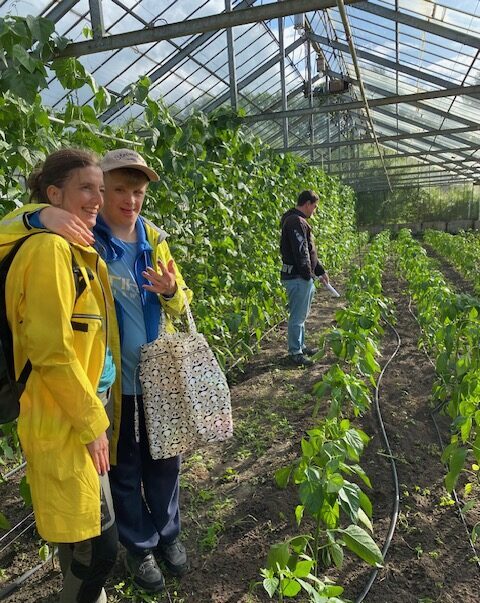




When you hear ‘leading from the vision’, you might think you have to come up with an abstract vision, a theoretical construct that you then use as a guiding principle for your actions. However, it is not quite like that. ‘Leading from the vision’ means thinking about what it actually looks like when you are satisfied with something, or example, I am satisfied when the chickens have been looked after before the break. This is a concrete image one has of a given situation. The starting point of the vision is therefore the concrete reality at hand, an external factor that does not directly relate to the people involved, a necessary task. Once you have a vision, you can share it with others and bring them on board. The others are then invited to get involved in their own way and make their contribution to the vision.
The practicalities
In our garden workshop, we always held our meetings in the group room. Together with the group, I tried to consider what work needed doing in the garden. We then wrote the tasks on the board. However, it was often difficult to actively involve the group in these meetings. Most of the time, it was just me who suggested or dictated what needed to be done. It was very controlling, and I couldn’t really get the others to participate actively. They simply did what I said without question. But it is important to me to guide them towards greater independence.
As part of the Inclutrain project, I then tried something new. We didn’t hold the meeting in the group room, but directly in the greenhouse. This allowed everyone to get a clear picture of what the garden currently needed during the meeting, for example, whether the tomatoes needed watering or the weeds needed weeding. My group was able to get involved and participate much more effectively. I brought a whiteboard so we could jot down the tasks. Communication took place not only through words, but also non-verbally, for example, when Christian pointed at something without naming it.
Then we looked at where we were going to sow the radishes. I created a vision by thinking about how big the radishes would be at harvest time. It became clear to everyone how much space we needed to leave between them when sowing, so that the radishes could grow well. Everyone then sowed in their own way, but with a clear understanding of why you shouldn’t just scatter the seeds haphazardly into the soil.
It was helpful to dive straight into the situation so that I could lead from the vision.
Whilst facilitating, I also noticed that asking questions isn’t always helpful. Sometimes it stops the flow rather than having an encouraging effect. People feel as though they are being interrogated, don’t dare to answer, or feel overwhelmed. Often, one also asks rhetorical questions. For example, if I ask, ‘Are you coming into the shed?’, that isn’t actually a question, but an invitation.
Jumping in and demonstrating
Leading from a vision also means getting involved yourself and setting an example. This invites others to join in and move with you. In doing so, communication takes place on a non-verbal level.
I asked Christian to pick the mugwort. But instead of getting on with the job, he just stood there beside me. I then intuitively decided to go over to the garden table with him and start picking it together with him. It worked. Christian got straight into it and carried on with the task even when I turned my attention to something else.